Three to five posts a week, held steady for months, is the right target for almost every med spa. The reason most practices never hit it has nothing to do with discipline or the algorithm. It is a supply problem: you are injecting patients from nine to six and there is no footage in the folder on Thursday night.
So the useful question is not "how often should we post." It is "what production system makes three good posts a week inevitable." Get that right and cadence stops being a weekly act of willpower.
The honest number
Three to five feed posts a week is enough volume to stay present without outrunning what you can actually produce. Push past that and the extra slots get filled with filler, which is where the cadence starts working against you.
Volume helps only if quality holds. The moment volume outruns your ability to produce something worth watching, the extra posts cost you.
You are also not competing with a newsroom, and you should stop benchmarking against one. A practice posting three strong pieces a week in its own market is in a different contest than a publisher posting five times a day.
Stories are the exception. They reward frequency in a way the feed does not, because they are cheap to make from footage you already have.
Consistency is the whole game
This is the part that should change how you plan. Steady weekly posting over months compounds, because the account builds a reliable audience and a back catalogue that keeps surfacing. A few weeks of effort does not.
That means roughly five months of showing up before you can fairly judge the system. Almost no practice that starts a content push in January is still posting in June, which is precisely why the ones who are own their local feed.
This is also why the sprint pattern fails so reliably. A clinic films everything in one burst, posts daily for three weeks, runs dry, goes dark for a month, then restarts with an apology post. A quieter three posts a week, every week, for six months beats it outright.
Why your cadence collapses
The breakdown is almost always in the same place. Not strategy. Not captions. Raw material.
A clinic running social in house usually has: no scheduled filming time, no shot list, one phone, a provider who feels awkward on camera, and a front desk team asked to "grab some content" between patients. Under those conditions, three strong posts a week is physically impossible, so the account defaults to whatever requires no production. Stock imagery. A manufacturer's reposted graphic. A quote card.
That content does not fail because it is unpolished. It fails because it contains no evidence that your practice is good at what it does.
The quarterly shoot: one day, ninety days of content
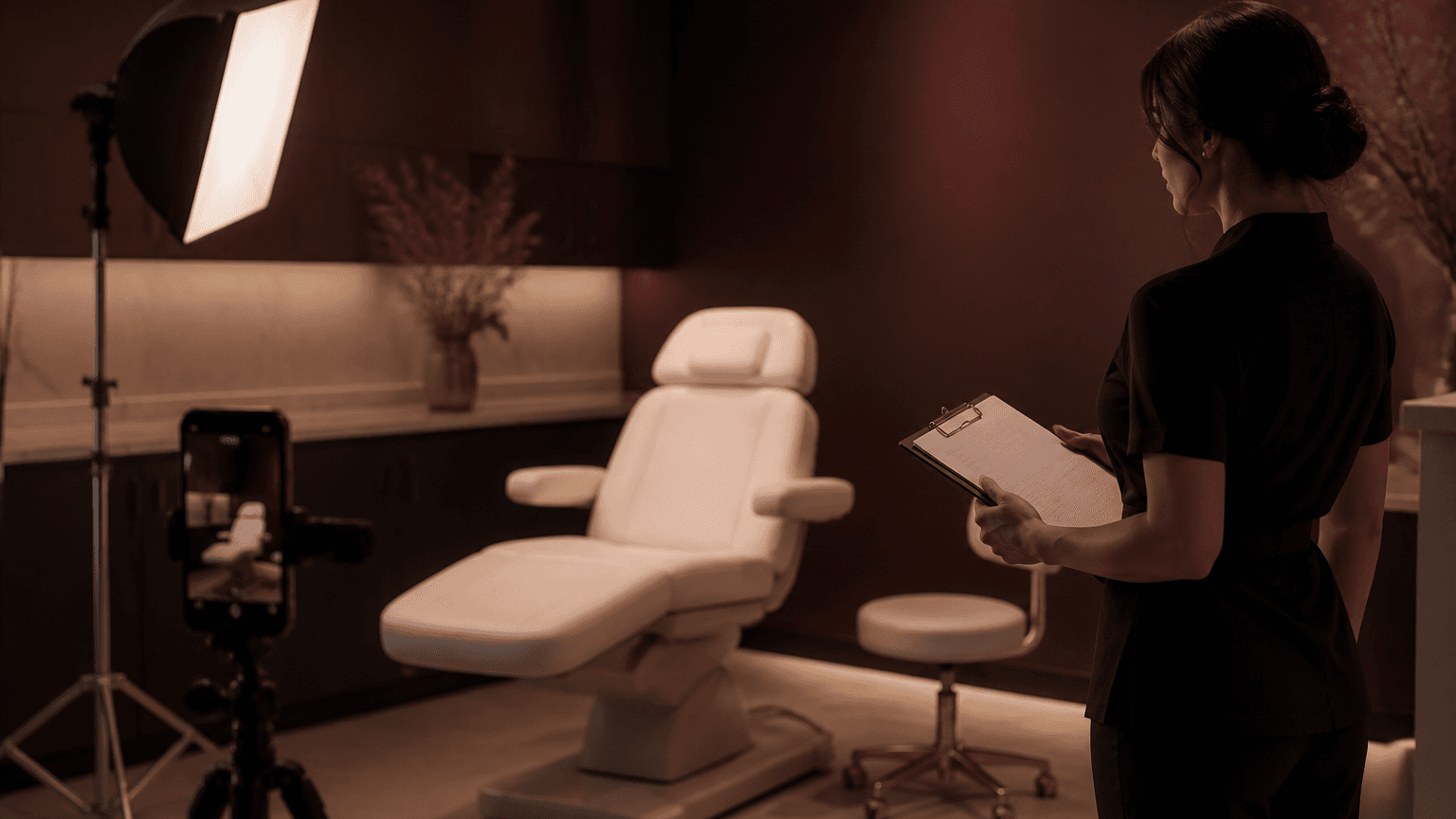
The fix is to separate production from publishing. You film in concentrated blocks and publish in a steady drip. One well run shoot day should carry a practice for a quarter.
What to capture on the day:
- Provider on camera, short answers. Twelve to twenty questions you actually get asked at consult. "How long does filler last." "Will I bruise." "What is the difference between these two treatments." One question per clip, sixty seconds or less. This is your highest value footage and the hardest to get any other way.
- Treatment room B roll. Hands, devices, prep, the texture of the room. Clean, well lit, no faces required. This is the connective tissue under half your posts.
- Space and team. Entry, waiting area, the people who greet patients. Prospective patients are deciding whether they would feel comfortable walking in.
- Consented patient moments. Reactions, short testimonials, outcome footage. Consent and documentation are not a formality here, and before and after use is governed by rules that vary by jurisdiction and by platform, so get your consent process and disclaimers reviewed by counsel or your state board before anything goes out.
- Offer and seasonal plates. Anything you know is coming in the next ninety days, filmed while the lighting setup is already up.
A day structured like that yields enough for three posts a week for a quarter, with room to recut the strongest pieces into Stories.
A realistic week
Four slots, rotating:
- Provider on camera. One clinical question answered plainly. This builds the trust that converts consults.
- Patient outcome. A result, a reaction, a story, with consent handled properly.
- Education. What a treatment does, who it suits, who it does not. Saying who should not book is the most credible thing you can post.
- Offer or invitation. A reason to book now. Roughly one in four, not one in two.
Stories daily, built from offcuts: behind the scenes, a question box, a reshare. They cost almost nothing when the quarterly footage exists.
Stop posting these
- Stock imagery. A model who has never been in your building is an admission you have nothing of your own to show.
- Manufacturer reposts. Every clinic in your city posts the same asset. It markets the brand, not your practice.
- Follower chasing. Giveaways and trend chasing bring in accounts that will never drive to your clinic. A thousand local followers beat ten thousand scattered ones.
- Vanity recaps. Impressions are not a result.
How to tell it is working
Watch consult requests, DMs asking about a specific treatment, saves and shares from local accounts, and the number of new patients who mention something they saw before booking. Add one question to your intake form: what made you reach out. That single line tells you more than any dashboard.
Expect the first real signal in weeks six to ten, and judge the system properly at month five.
We build this system for aesthetic practices: recurring shoot days, the shot list, the editing, the posting, and reporting on consults rather than impressions. If your calendar is not full and your feed has gone quiet, that is usually one problem, not two. A free fifteen minute discovery call is the easiest way to find out which.
Frequently asked questions
How many times a week should a med spa post on Instagram?
Three to five feed posts a week is the right target for most practices. Buffer's analysis of over two million Instagram posts found that range roughly doubles follower growth rate compared with one or two posts and lifts reach per post by about 12%. Dash Social's study of around 1.5 million posts found two to three feed posts weekly produced the highest engagement rates, so anywhere in that band is defensible if the quality holds.
Is posting every day better for a med spa?
Only if quality holds, and for most clinics it does not. Buffer's data shows volume keeps helping with diminishing returns, but their own data scientist notes quality is still the dominant factor and low quality volume does not move reach. Dash Social found brands posting more than two to three times a week to feed saw lower engagement rates, so daily filler usually costs you.
How long before social media brings in consults?
Plan on months, not weeks. Buffer tracked more than 100,000 users over 26 weeks and found accounts posting at least weekly for 20 or more of those weeks saw 450% more engagement per post than accounts posting fewer than five times, with engagement peaking around week 21. Expect early signals in weeks six to ten and judge the system properly at month five.
How do I produce enough content when I am treating patients all day?
Separate production from publishing. Film in concentrated quarterly shoot days covering provider question and answer clips, treatment room B roll, team and space footage, consented patient moments and seasonal offer plates, then publish that material three times a week for ninety days. The constraint is footage supply, not posting discipline.
Can I post patient before and after photos?
Only with proper consent, and the rules vary. Consent documentation, disclaimers and before and after use are governed by requirements that differ by jurisdiction and by platform policy, with your state medical board among the deciders. Have your consent process and disclaimers reviewed by counsel or your board before anything is published.